Every business reaches a point where extra funding becomes more than a luxury—it becomes a lifeline. Maybe your company is scaling quickly and needs new equipment. Maybe your seasonal income just isn’t enough to carry through the slow months. When you start exploring financial solutions, two common funding paths often stand out: the business line of credit and the term loan.
Though both are used to fund businesses, qualifying for each one requires a different approach, a different set of documents, and in many cases, a different financial story. Understanding what lenders are actually looking for behind the scenes can save you time, reduce your chances of rejection, and help you prepare the strongest application possible.
Let’s break down exactly how qualifying for a line of credit compares to a term loan—and what you can do to boost your chances of approval for either one.
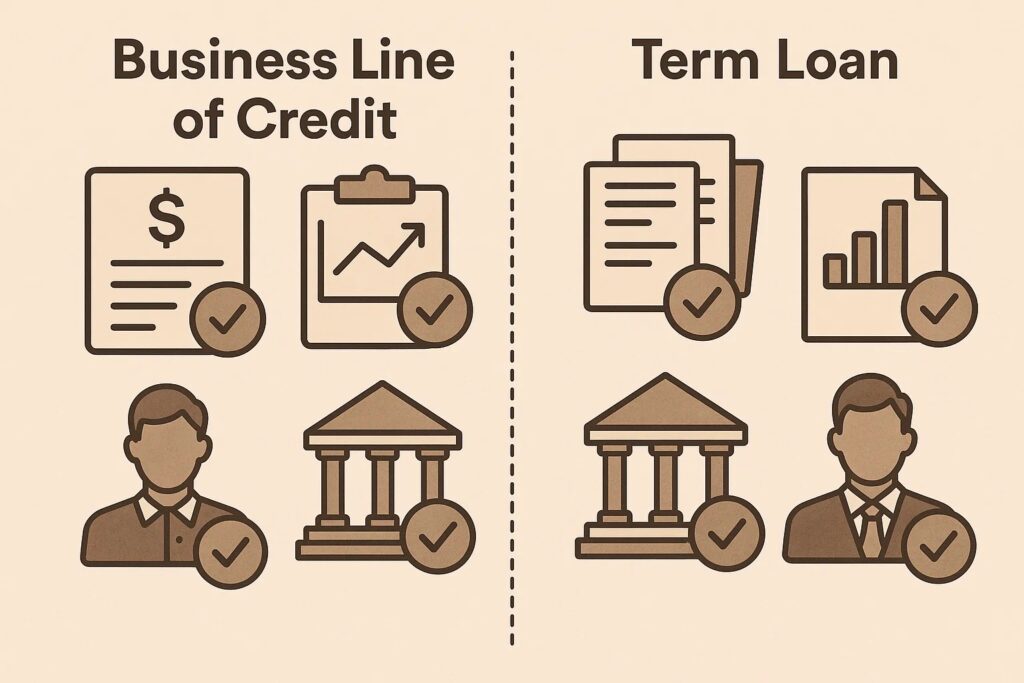
The Basics: What’s the Difference in How They Work?
A business term loan is fairly straightforward. You borrow a specific amount of money, receive it all upfront, and repay it over a predetermined period—usually with fixed monthly payments. This kind of loan is often used for big, one-time expenses: buying equipment, funding expansion, or refinancing other debts.
On the other hand, a business line of credit is more like a financial safety net. It provides you with a pool of funds you can draw from whenever you need to. You only pay interest on what you actually use, and once you repay what you’ve borrowed, that credit becomes available again. It’s a revolving credit source, not unlike a credit card, and is often used to smooth out cash flow or manage short-term needs.
Because these two financial tools operate differently, lenders evaluate applicants differently for each.
Credit Score: How Good Does It Need to Be?
Your credit score is often the first gatekeeper. For term loans, most lenders look for a personal credit score in the mid-600s or higher, especially if you’re applying through a traditional bank. However, online lenders may approve scores in the low 600s, though that typically comes with higher interest rates and shorter repayment terms.
When it comes to a business line of credit, the bar is often set even higher. Because it provides ongoing access to capital, lenders want to feel confident that you won’t max it out irresponsibly. Scores of 680 or above are commonly expected, and some lenders prefer scores in the 700s for unsecured lines.
Keep in mind: lenders may review both your personal and business credit reports. It’s wise to review both before applying.
Time in Business: Does Longevity Matter?
Yes—especially for a line of credit. Lenders often feel more comfortable approving revolving credit for businesses that have shown stability over time. A company that’s been operating for at least 2 years has a better shot at securing a line of credit, though some online lenders may accept a shorter history if other factors—like revenue—are strong.
For term loans, the time-in-business requirement can be a little more flexible. Some fintech lenders are open to funding businesses that are as young as six months to one year old, particularly if monthly revenue is strong.
Either way, having a proven track record helps, and longevity is often used as a proxy for reliability.
Revenue Requirements: How Much Are You Earning?
Both options demand proof that your business is bringing in consistent income, but they emphasize it in slightly different ways.
For term loans, many lenders want to see at least $100,000 in annual revenue, or $8,000 to $10,000 per month, depending on the size of the loan. But fluctuations from month to month might not be a dealbreaker.
When it comes to qualifying for a line of credit, consistency matters more. Since this type of loan involves repeated access to funds, lenders want to be sure your cash flow is steady, not just large. They’ll look closely at your bank statements, possibly going back 6 to 12 months, to confirm that your income is predictable and timely.
If your business has highly seasonal income, be prepared to explain the pattern and offer supporting documents such as contracts, forecasts, or previous seasonal cycles.
Collateral: Is Security Needed?
The need for collateral depends on how much you want to borrow and how risky the lender sees your application.
Some term loans are secured, especially larger ones, and may require you to pledge business assets like vehicles, real estate, or equipment. Smaller, short-term loans are often unsecured but come with higher interest.
Lines of credit, especially those with higher limits, are often secured by inventory, accounts receivable, or cash deposits. Unsecured lines exist, but they’re harder to qualify for, and lenders offset their risk by tightening approval criteria.
If you’re willing to secure your loan, you may qualify for better terms, so have a list of assets ready if needed.
Documentation: What Will You Need to Show?
Getting approved for either financing option means proving that your business is financially sound. Here’s what’s typically expected:
For a term loan:
- Business tax returns (1–2 years)
- Profit & Loss statements
- Business bank statements (3–6 months)
- A list of existing debts
- Possibly a business plan
For a line of credit:
- Business bank statements (often 6–12 months)
- Accounts receivable aging reports
- Balance sheets
- Tax returns
- Revenue projections
The line of credit process can sometimes involve more ongoing financial check-ins even after you’re approved. Be prepared to keep your financials updated.
Which One Is Easier to Get?
There’s no universal answer. If your business is new, growing quickly, and needs a one-time infusion of capital, you might find it easier to qualify for a term loan. If your company is more established, with healthy cash flow and strong credit, a line of credit offers more flexibility—but you’ll have to clear a higher bar.
Here’s a quick breakdown:
| Criteria | Term Loan | Line of Credit |
|---|---|---|
| Credit Score | 650+ (some leniency online) | 680+ preferred |
| Time in Business | 1–2 years (can be less) | 2+ years ideal |
| Annual Revenue | $100,000+ | $150,000+ preferred |
| Collateral Required? | Sometimes | Often, especially for higher limits |
| Approval Time | 1–7 days (online) | 1–2 weeks |
Prepare Now, Apply Smart
Too many businesses dive into the loan process blind, hoping for a quick win. But understanding the differences in how lenders assess each type of loan can save you time, protect your credit score, and increase your odds of getting approved the first time around.
Whether you’re leaning toward a line of credit or a traditional term loan, preparation is the single most powerful tool you have. Check your credit, organize your documents, evaluate your revenue patterns, and be honest about your risk profile. Doing the homework upfront doesn’t just help you get funded—it helps you choose funding that truly fits your business model.
The written content on this page was generated by ChatGPT.